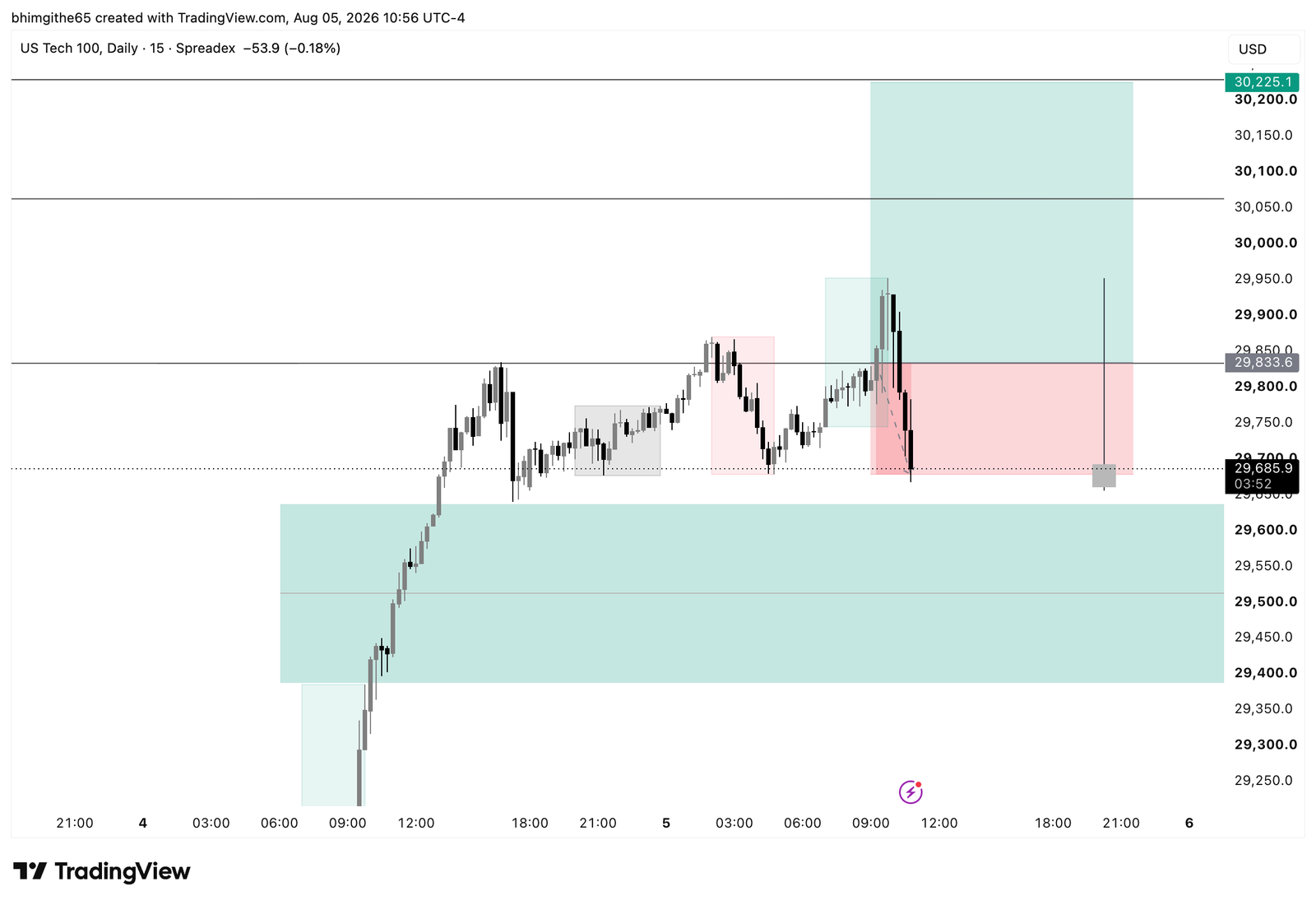
This NDX100 trade journal reviews a buy I took during the New York session on August 5, 2026. I entered at 29,833.6, placed my stop at 29,678.6 and set a target at 30,225.1. The stop was hit for a recorded loss of 155 index points and approximately -0.7R. I marked the setup as “not valid,” which makes the reason for reviewing this trade very clear.
Before the trade I felt fear of missing out, and afterward I felt frustrated. I tagged no pullback, forced entry and FOMO as my mistakes. My written reason for entry was also fear of missing out. This was not a case where a carefully defined setup failed; it was a case where I entered before I had the setup I require.
The 4-hour context
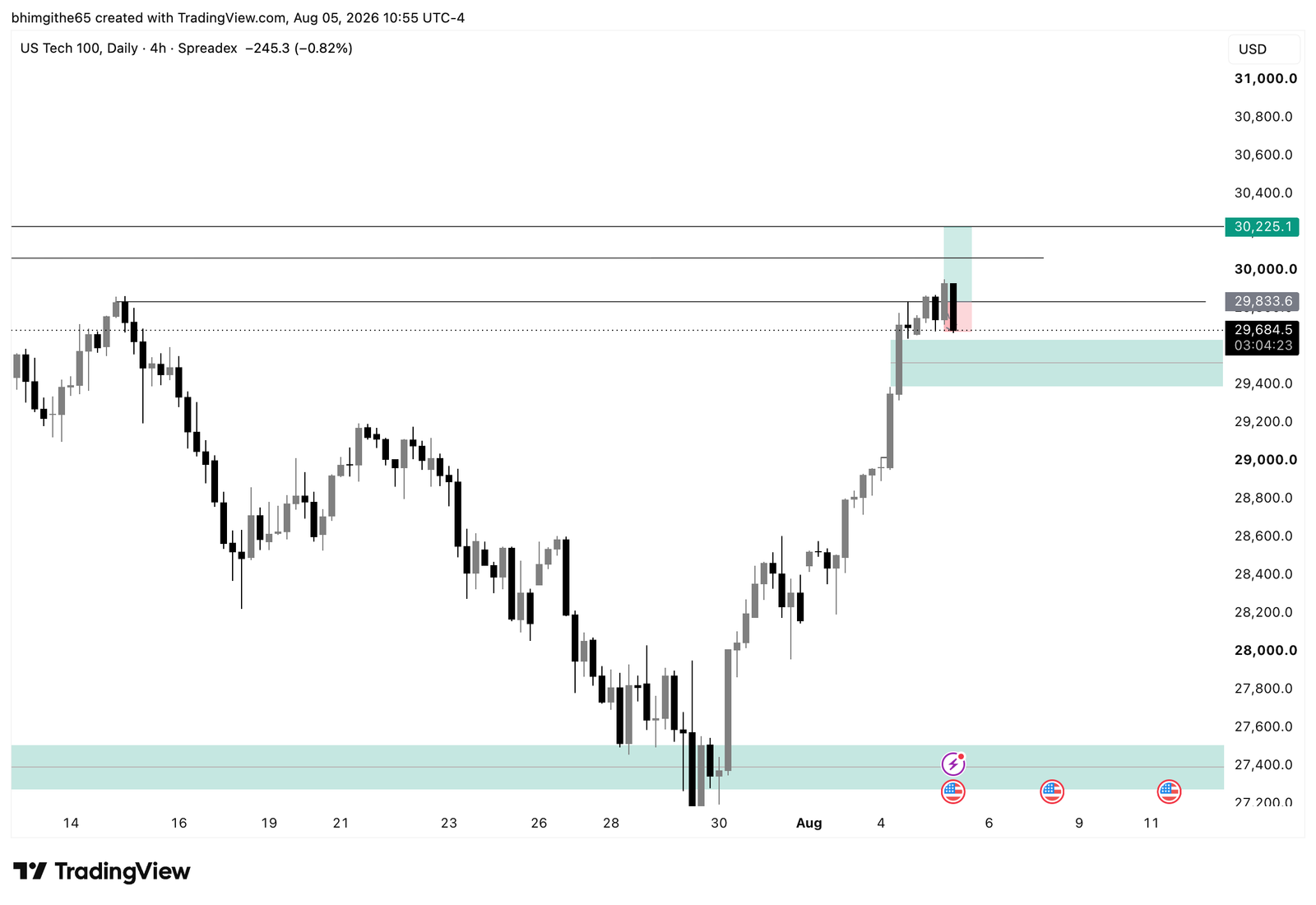
I saved three screenshots and identified them as 4-hour, 1-hour and 15-minute views. Although the files were saved in a different order, I have arranged them from the higher timeframe down. The 4-hour chart shows the broad NDX100 movement around the period of the trade.
A higher-timeframe chart can provide context, but context alone is not a trigger. My journal does not record a valid bullish setup on the 4-hour chart. I therefore cannot use the wider view to justify the buy afterward. It is here to show where the trade sat within the larger movement and to keep the review grounded in the original evidence.
What I needed to see on the 1-hour chart
My lesson says that a setup exists only when price respects or disrespects a price-delivery area such as a fair value gap, fair value area, swing high or swing low, together with a two-candle rejection. That was the decision framework I wanted to follow.
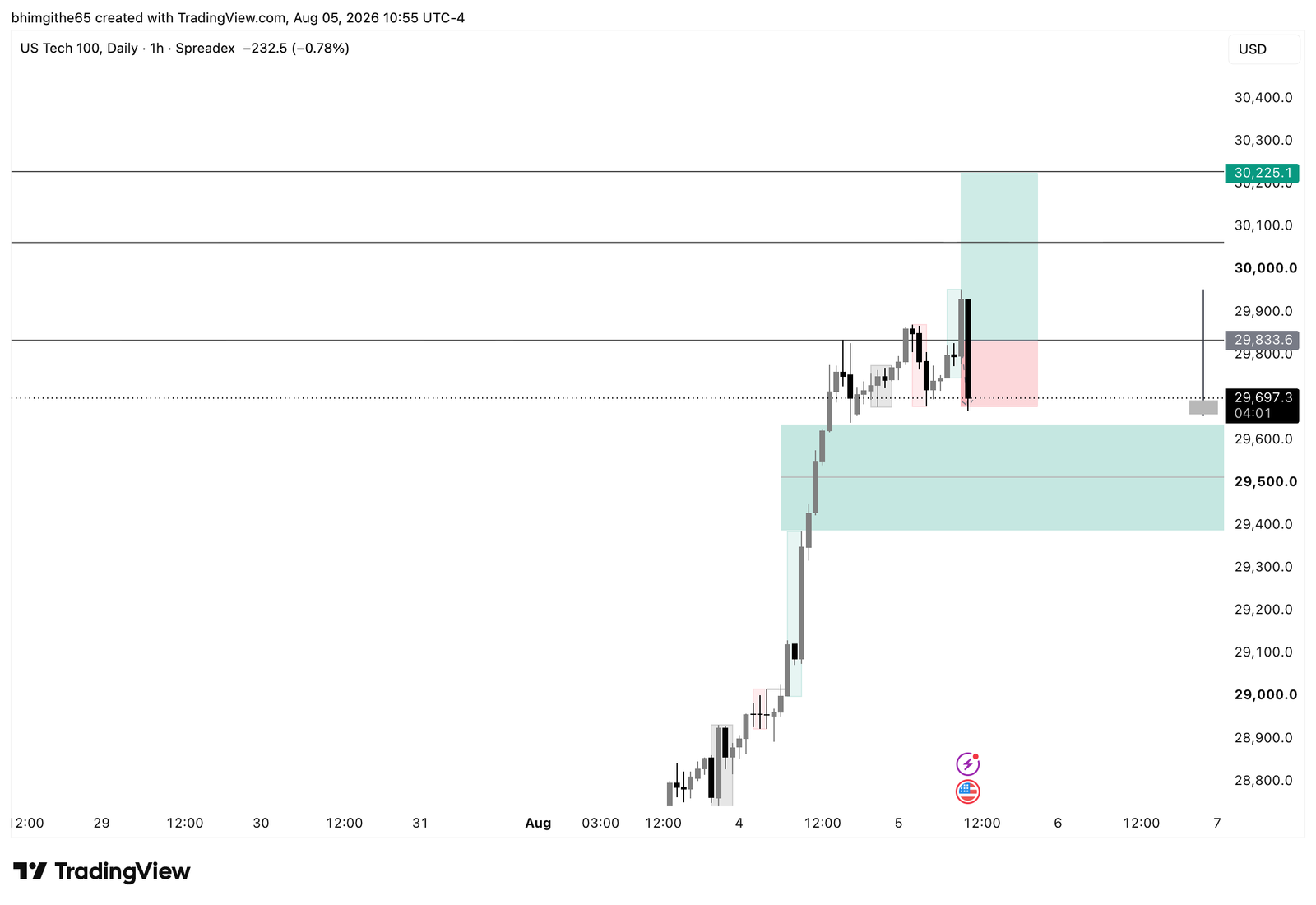
The 1-hour screenshot shows the marked trade and the area price later moved toward. In my “What Price Did Later” note, I wrote that price moved down toward the FVG. This supports the mistake tag “no pullback”: I bought before allowing price to reach and react around the area I was watching.
The 15-minute entry and the role of FOMO
The 15-minute chart gives the closest view of the position. My entry was 29,833.6 and the stop was 155 points below it. The planned target was 391.5 points above the entry, but that reward remained only a plan because the stop was hit first.
FOMO changes the question in my mind. Instead of asking whether my conditions are present, I start asking whether I will miss the move. That pressure makes waiting feel like a loss even though no money has been risked. In this trade, it led to a forced entry without the pullback and rejection I wanted.
Why a stop cannot repair a missing setup
The stop limited the trade, but risk management begins before stop placement. If the setup is invalid, choosing a stop distance does not supply the missing evidence. The 155-point loss was the financial result of a decision that had already moved away from my rules.
I recorded frustration afterward. That emotion is understandable, but the useful response is not to find a new trade quickly. It is to identify the skipped condition. Here, the skipped conditions were the pullback into a relevant area and the reaction that would show respect or rejection.
The lesson I will use before the next entry
My journal states the rule directly: when there is no setup, do not trade. I want to make that rule observable. Before entering, I should be able to name the relevant FVG, fair value area or swing level, then describe the two-candle rejection or other planned response I actually saw. If I cannot point to those conditions, the correct status is “waiting.”
This NDX100 trade journal does not tell me that every pullback will produce a winning trade. It tells me that FOMO pushed me to accept less evidence than my process requires. The next improvement is not predicting the index more aggressively. It is allowing the market to reach my area, watching its response, and accepting that some moves will leave without giving me an entry.
This is a retrospective trading journal for education, not a recommendation to enter a trade. The featured cover is AI-generated editorial artwork; the three TradingView charts are the original journal screenshots.