
This is the first entry in my public trade journal. I’ll be logging real trades from my forex trade journal here — the wins, the losses, and everything in between. No cherry-picking, no hindsight editing. Just the plan, the execution, the result, and the lesson, laid out exactly as I logged it. If you’re brand new to this, it’s worth starting with my beginner’s guide to forex trading before diving into a trade breakdown like this one.
Disclaimer: This post documents a personal trade for educational and record-keeping purposes only. It is not financial advice or a signal to copy. Trading forex carries significant risk, and past results don’t predict future ones.
The Setup: Reading the Trend Top-Down
Pair: USD/CHF
Direction: Buy
Session: New York
Date: July 13, 2026
Every trade I take starts with a top-down analysis — checking the bigger picture before zooming into the exact entry. Here’s how that looked for this one:
4-hour chart: The overall trend was bullish. This is the most important filter for me — I only look for buy setups when the higher timeframe agrees, instead of fighting the dominant direction.
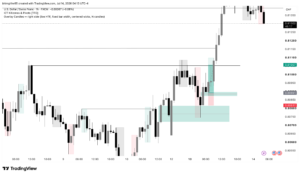
1-hour chart: Price had left behind a Fair Value Gap (FVG) — a gap that forms when price moves so fast in one direction that it skips over a price range without much trading happening there. That imbalance often acts like a magnet — price tends to come back and “fill” it before continuing on its original path.
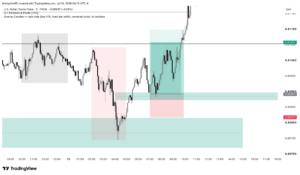
15-minute chart: This is where I look for confirmation. A market structure shift (MSS) appeared — a change in the pattern of highs and lows that signals momentum has actually turned, not just paused. When price pulled back into the 1-hour FVG at the same time the 15-minute structure confirmed bullish momentum, that alignment across three timeframes was my green light to enter.
The Trade, Exactly As Logged
| Entry Price | 0.80891 |
| Stop Loss | 0.80817 |
| Take Profit | 0.81057 |
| Result | Win — 16.6 pips |
| Risk:Reward (actual) | 2.24 |
My stop loss sat just below the candle that formed the FVG. That’s a deliberate choice, not a random number — tight enough to keep my risk small if I was wrong, but far enough away that normal market noise wouldn’t stop me out of a trade that was actually still valid. Setup tags I logged for this trade: Session Sweep, FVG Retest, Pullback Entry, FVG Tap Entry, and 15-Min MSS.
[Second chart screenshot: USD/CHF 15-minute chart showing the market structure shift and entry candle — to be added]
Mindset: Before and After
Going into the trade I felt confident. That confidence wasn’t blind optimism — it came from having three timeframes agree before I risked a single dollar. After the trade closed, I felt satisfied. Not euphoric, not relieved — satisfied, because the outcome matched a plan I’d actually followed. That distinction matters more than it sounds. A lot of new traders feel relief when a trade wins, which usually means they weren’t confident in the setup to begin with.
The Mistake I Almost Didn’t Notice
Here’s the part I want to be completely honest about, because it’s easy to only post the parts that make you look good. This trade is logged as a win, and by my own rules it was a clean, mistake-free execution — no forced entry, no ignoring the higher timeframe, no FOMO. But when I look at what price did after my take-profit was hit, there’s a real mistake hiding inside this “perfect” trade.
Price kept climbing well past my exit at 0.81057. My own notes on this trade say it plainly: if I’d set my target at a 1:3 risk-to-reward ratio instead of the fixed target I used, I would have captured significantly more of that move. I closed the trade too early — not because the setup failed, but because I capped my upside before the market told me to.
This is a mistake that doesn’t show up if you only track win/loss. It only shows up when you track what price did after you exited, which is exactly why that field exists in my journal. A trade can be a “win” by your own rulebook and still leave real money on the table because your exit strategy was more conservative than the setup deserved.
Lesson Learned
Two lessons came out of this one, and they build on each other:
1. Follow the real plan, then leave it alone. Once I placed the trade, I didn’t hover over the chart second-guessing it. The setup had already done its job by the time I entered — trusting it was the actual edge, not staring at candles waiting for a reason to panic.
2. A fixed take-profit isn’t always the right tool. On strong trend-day setups like this one — where the higher timeframe, the FVG, and the structure shift all lined up — a trailing stop or a wider R:R target would have let the trade breathe and capture more of the move, instead of exiting the moment a static number was hit. If you want to see this idea applied with a different indicator set, I broke down a similar trend-following approach in my Bollinger Bands swing trading guide.
Going forward, I’m going to start testing wider R:R targets specifically on setups where all three timeframes agree this cleanly, and log the results here so I can see, with real data, whether that actually improves my numbers or just feels like it should.
That’s trade journal entry #1. Going forward, I’ll post a recap like this on any day I take a trade, and a market/finance topic post on days I don’t. Follow along if you want to see how a real trading journal builds up over time — clean trades, messy ones, and everything I learn from both.