This EURUSD trade journal reviews a London session sell I took on July 21, 2026. I based the idea on an Asian-session sweep and a one-minute market structure shift from a fair value gap. I entered at 1.14218, placed the stop at 1.14276, and planned a target at 1.14089. Price hit the stop, producing the recorded 5.8-pip loss and a result of minus 1R.
Before entering I marked myself confused, and afterward I marked myself regretful. I also selected Early Entry and Forced Entry as the mistake tags. Those details matter because they show that uncertainty was present before I committed risk. The later move toward the target does not erase the fact that my original timing was stopped out.
The plan and the information I had
The sell risk was 5.8 pips from the entry to the stop, while the planned target was 12.9 pips below the entry. The potential reward was more than twice the risk, but a favorable ratio cannot repair an entry that lacks the confirmation required by my rules. The actual outcome remained minus 1R.
My reason field was short: Asian-session sweep and a one-minute MSS from an FVG. A session sweep describes price moving beyond a prior session high or low before reversing. A market structure shift describes a change in the recent sequence of highs and lows. I saw those ideas, but my review says the confirmation was not strong enough.
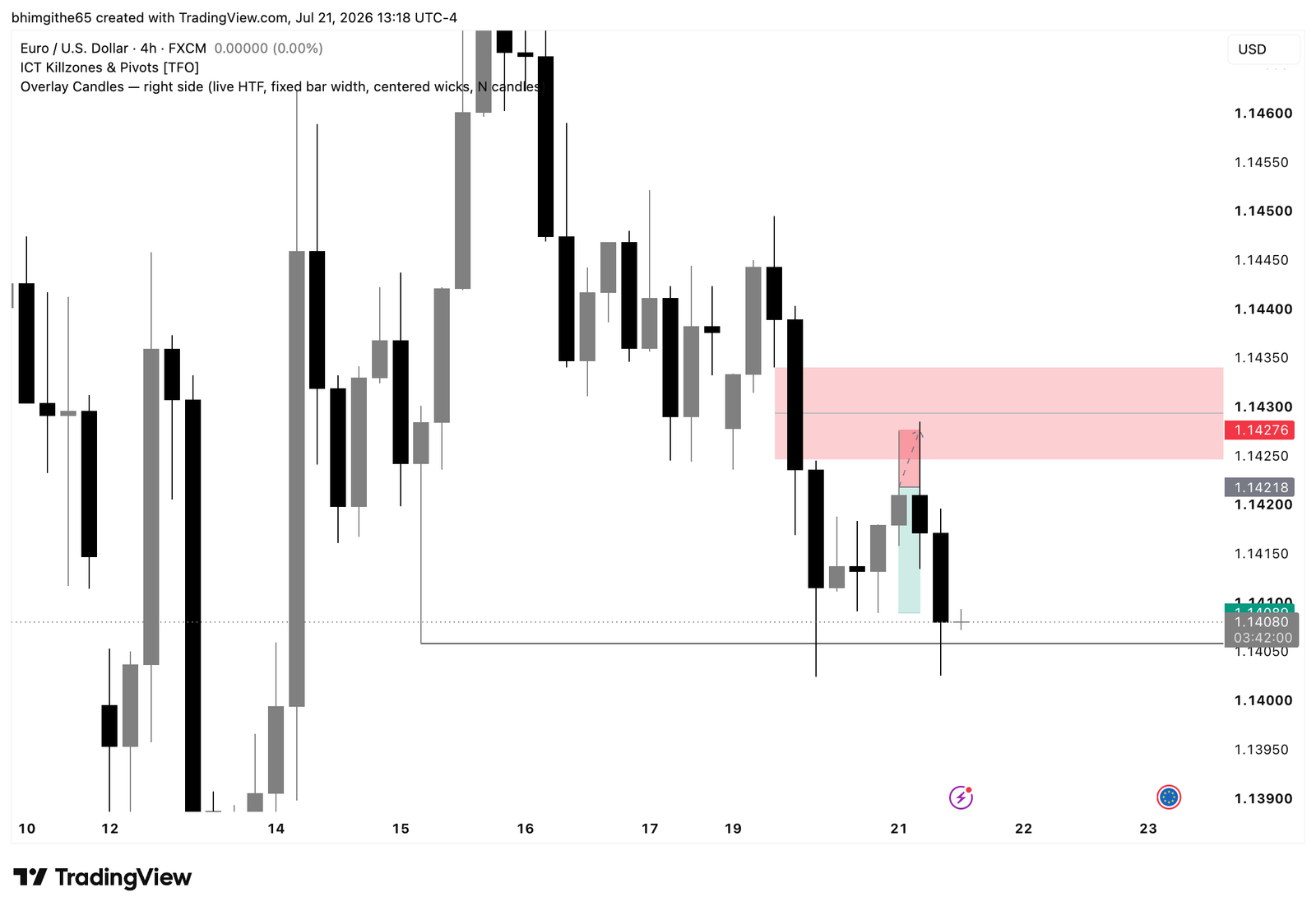
Four-hour chart: the fair value gap context
The four-hour screenshot shows the broader EURUSD context and the marked trade near the higher-timeframe fair value gap. This was the area that made a bearish idea possible, but my lesson says a four-hour gap requires clear bearish momentum on the 15-minute chart before I enter.
That rule is important because a high-timeframe area can remain active while price moves around inside it. A touch alone does not tell me exactly when the move will begin. The chart helps me see why a smaller-timeframe entry could be stopped before the larger bearish move develops.
15-minute chart: momentum was the missing filter
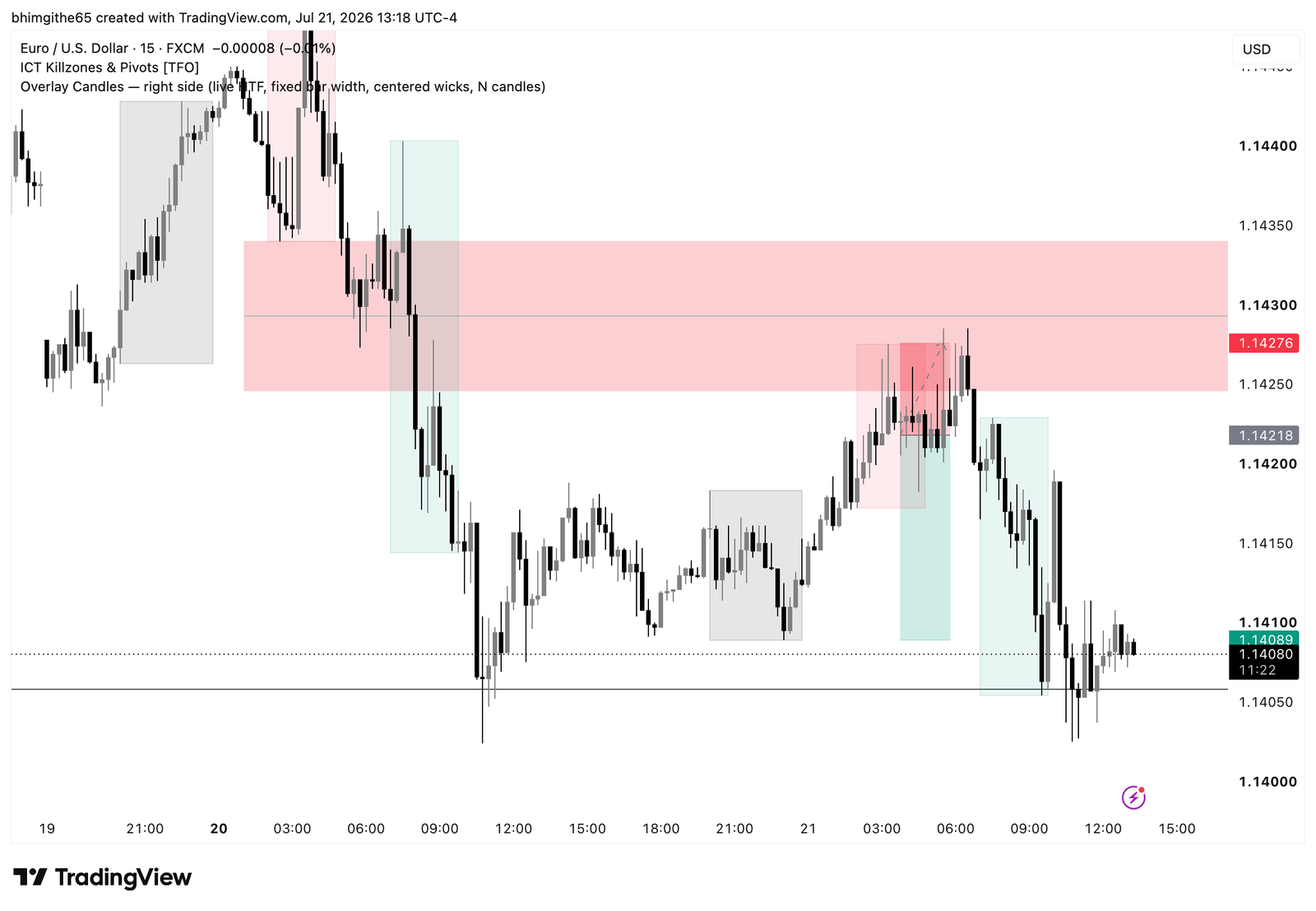
The 15-minute screenshot shows the trade area, the move up into the stop, and the decline that followed later. My journal specifically says I should have waited for clear bearish momentum on this chart when working from a four-hour fair value gap.
Clear momentum could appear as displacement or a convincing market structure shift according to my rules. The key point is not to invent a signal after the event. My saved notes identify the missing filter, and the Early Entry tag confirms that I acted before that condition was strong enough for me.
The stop was hit before the bearish move
Price reached 1.14276 and closed the trade at the stop. Later it moved down toward the original target. That can feel frustrating, especially because the directional idea eventually appeared, but the journal must keep the sequence honest: the stop was hit first, so the realized result was a loss.
A later move toward the target does not mean the stopped entry should be counted as correct. It means the direction and the timing were two different decisions. My analysis may have identified a bearish possibility, while my execution entered before the market provided the confirmation and space required by the plan.
What the emotions tell me
I recorded confusion before the trade. That is useful information because it suggests I did not have a clean yes-or-no decision at the moment of entry. Instead of treating confusion as something to push through, I can use it as a prompt to check whether every required condition is actually present.
Regret after the stop can also tempt me to focus on the later decline. The better review is to connect the emotion with the process: I forced an early entry, the stop was reached, and the market moved later without me. Waiting might still have resulted in no trade, but it would have kept me aligned with the confirmation rule I wrote.
The confirmation rule for the next setup
My lesson separates confirmation by timeframe. For a four-hour fair value gap, I want clear 15-minute bearish momentum. For a one-hour fair value gap, I want bearish or bullish momentum on the five-minute chart, possibly through a market structure shift or displacement.
This EURUSD trade journal is valuable because the loss exposed a precise weakness rather than a vague problem. The next improvement is to delay the entry until the required timeframe confirms the idea. I cannot control whether the later trade wins, but I can control whether I enter while confused or wait until my rules are visible on the chart.
Related reading: my earlier NDX100 journal about waiting for lower-timeframe confirmation.
This is a retrospective trading journal, not a recommendation to enter a trade. The featured cover is AI-generated editorial artwork; the 2 TradingView charts are the original journal screenshots.