
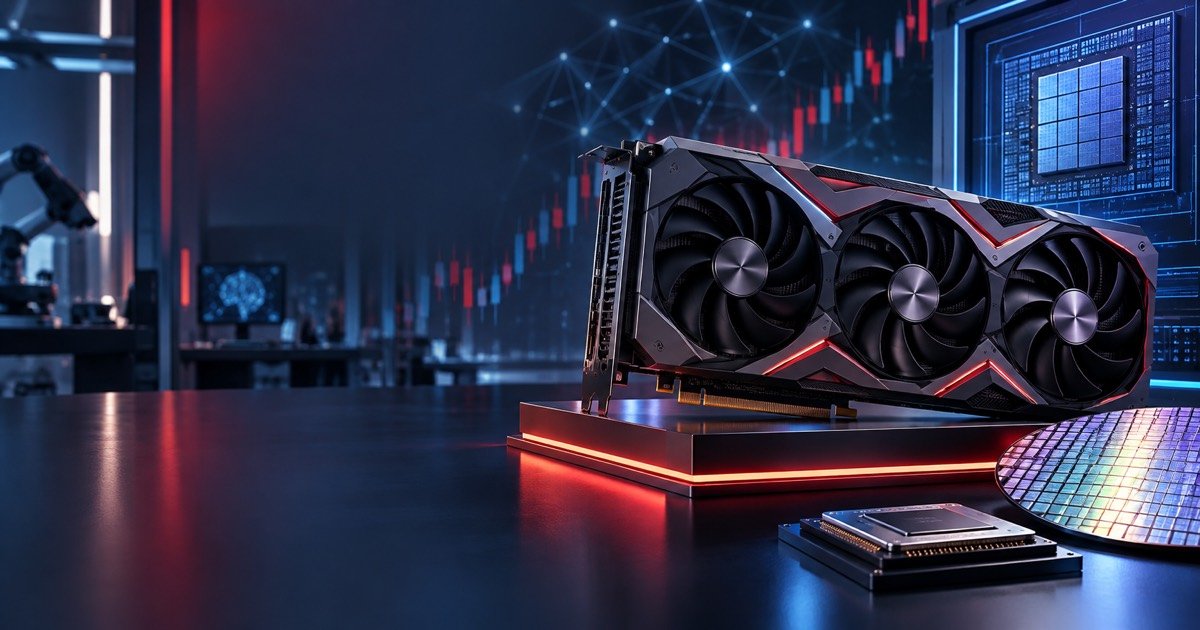
Why AMD Radeon is drawing fresh attention
AMD Radeon appeared among active US Google Trends searches on September 21, 2026, with more than 10,000 searches and a reported 1,000% increase in interest. Search data shows that attention is rising, but it does not identify a single confirmed cause or tell investors whether AMD shares will rise. The more useful approach is to place that attention beside AMD's recent product and financial information.
AMD has recently highlighted Radeon across gaming, professional graphics and local artificial-intelligence workflows. Its September software release added game support and fixes for current Radeon products, while the company's recent Advancing AI material described a software path that can move projects from Ryzen AI PCs to Radeon workstations and then to larger Instinct accelerators. Together, these updates show why Radeon is more than a gaming label inside AMD's strategy.
Radeon now connects gaming and local AI
For many consumers, Radeon still means a graphics card built primarily for games. That market remains important. AMD's current Radeon product page promotes the RX 9000 family and the RDNA 4 architecture, with ray-tracing and AI acceleration among the main features. Driver support also matters because a graphics card's value depends on stable performance, compatibility and improvements after purchase.
The investment angle becomes broader when Radeon hardware is used for creation, engineering and local AI. AMD's September 16 discussion of agentic PCs described developers starting with models on Ryzen AI systems and carrying tools to Radeon workstations or Instinct GPUs as workloads grow. If AMD can make that path simple, it may strengthen the usefulness of its hardware portfolio and its ROCm software ecosystem. That is a strategic possibility, not proof that Radeon has already captured a large new AI market.
What the latest financial results show
AMD's second-quarter 2026 report provides a firmer base than search interest. The company said Client and Gaming segment revenue was $3.8 billion, up 6% from the prior-year period. AMD also cited wider availability of Radeon RX 9070 GRE graphics cards among its recent product developments. These figures cover more than Radeon alone, so they should not be treated as a direct measurement of graphics-card revenue.
The segment result does show that consumer processors and gaming products remain financially relevant even as investors focus heavily on data-center AI. A diversified product mix can reduce dependence on one market, but it can also make analysis harder. Investors need to separate growth coming from client CPUs, semi-custom gaming chips and discrete Radeon graphics rather than assuming that every improvement comes from the same product line.
The software question investors should not ignore
Hardware specifications attract attention, but software determines how easily customers can use computing power. In gaming, driver quality, game compatibility and features such as upscaling influence user experience. In AI, developer tools, supported models and deployment workflows can be even more important because customers do not want to rebuild an application every time they move to different hardware.
AMD is presenting ROCm.AI as a more consistent route across Ryzen, Radeon and Instinct. The opportunity is clear: a developer could experiment locally, scale to a workstation and later move to data-center infrastructure while staying within a familiar toolset. The risk is execution. Competing ecosystems have large installed bases and mature developer communities. Investors should track adoption, customer examples and software reliability instead of evaluating the strategy only through announcement language.
Four signals worth monitoring
First, watch gaming and client segment revenue and margin rather than search volume alone. Rising attention is encouraging only when it leads to sustained demand at acceptable profitability. Second, follow availability and pricing across the Radeon product range. A competitive product that is difficult to buy, heavily discounted or costly to produce may not create the expected return.
Third, look for measurable developer adoption of Radeon and ROCm in professional and local-AI workloads. Named customers, supported applications and repeatable performance tests are more useful than broad claims. Fourth, monitor AMD's total capital and research priorities. Radeon competes for engineering resources alongside EPYC server processors, Instinct accelerators, Ryzen CPUs and embedded products. Strong execution requires AMD to coordinate those investments without weakening the areas that currently produce the greatest returns.
What the trend does not tell us about AMD stock
Google Trends measures relative search attention. It does not measure product shipments, profit, market share or investor sentiment. A spike can come from a driver update, a popular game, a product rumor, shopping interest or a technical problem. Without additional evidence, the cause should not be presented as certain.
The same caution applies to short-term stock reactions. AMD shares are influenced by data-center demand, competition, supply conditions, valuation, interest rates and the wider semiconductor market. Radeon news may contribute to the story, but it is only one part of the business. Investors should avoid turning a consumer-search spike into a price target or a prediction about the next trading session.
How to evaluate the next Radeon update
When AMD releases new Radeon information, separate confirmed specifications from company comparisons and independent tests. Check whether performance claims use similar systems and settings, then consider price, power use, software support and actual availability. For financial analysis, connect those product facts to segment revenue, gross margin and management commentary.
This process is similar to reviewing a trading setup: one signal is rarely enough. RichClue's NDX100 trade journal shows how context and confirmation can matter more than reacting to the first move. With Radeon, the search trend identifies a topic worth studying; company filings and execution should determine the investment conclusion.
The main takeaway
Radeon's renewed search interest arrives while AMD is trying to connect gaming graphics, professional workstations and local AI development. That combination could make Radeon strategically more valuable than a stand-alone gaming product. AMD's recent segment growth and product expansion provide evidence that the wider client and gaming business remains meaningful.
The open question is whether AMD can convert technical progress and attention into durable demand, attractive margins and a stronger software ecosystem. Investors should watch those measurable outcomes. The trend is a reason to research AMD, not a reason by itself to buy or sell the stock.
Sources
- Google Trends — Trending Now, United States
- AMD — Advancing AI 2026
- AMD — Second-quarter 2026 results
- AMD — Radeon software 26.9.1 release notes
- AMD — Radeon RX graphics products
Related reading: NDX100 trade journal and the wealth-building strategies.
This article is for educational information and does not provide individualized investment advice.